Cybersecurity architecture is not a stack of products. It is a system for continuously deciding what matters, observing what is happening, identifying dangerous behaviour, enforcing policy and restoring the business when prevention fails. The old perimeter model assumed that trusted people and systems sat inside a corporate network. Modern enterprises have no single inside: users are remote, applications are assembled from cloud services and APIs, data moves through SaaS platforms, and human, machine and AI identities act across several environments. The durable architecture therefore protects resources rather than locations and connects governance, identity, data, telemetry, detection, response and recovery in one feedback loop.
The architecture in one sentence
A modern security architecture discovers every important resource and identity, grants the minimum access required, collects high-quality telemetry from each control point, correlates weak signals into an attack story, responds at machine speed within explicit guardrails, and uses the outcome to improve policy. Data flows upward from assets and enforcement points; decisions and actions flow downward; governance and resilience surround the entire cycle.
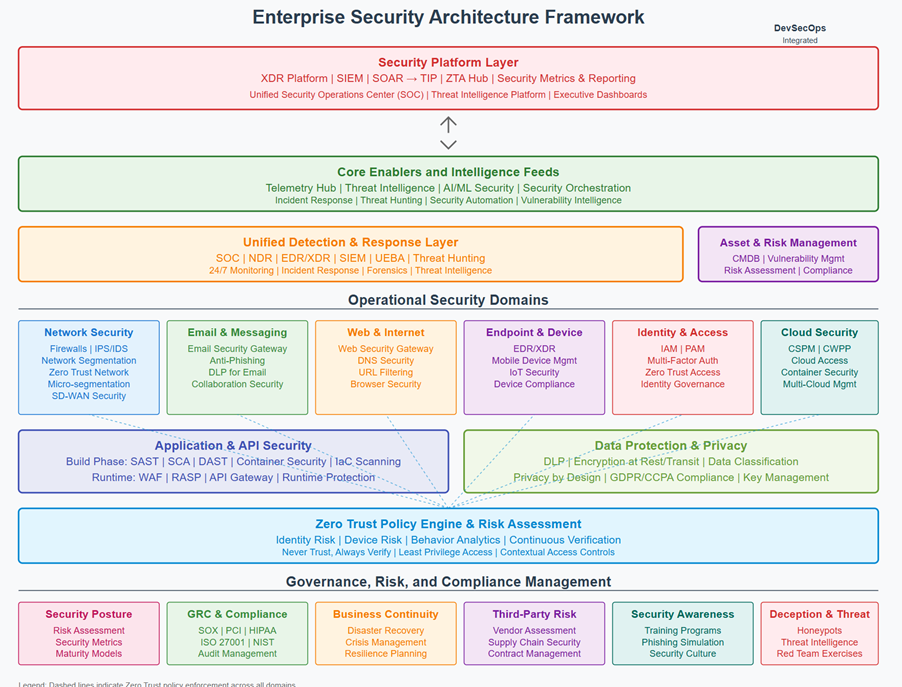
The diagram is a useful map, but the arrows matter more than the boxes. An endpoint, identity provider, firewall, SaaS application or cloud workload produces an event. Context from asset inventory, threat intelligence and business ownership determines whether it matters. Detection systems connect the event to related behaviour. A control plane decides what action is permitted. Enforcement happens back at the identity, endpoint, network, cloud or application layer. The incident and its business impact then update policy, controls and recovery plans.
Why the perimeter model broke
The corporate perimeter was a reasonable abstraction when employees worked in offices, applications lived in company data centres and most traffic crossed a small number of gateways. Firewalls separated a trusted internal network from an untrusted internet; antivirus searched devices for known malicious files; virtual private networks extended the trusted network to remote users. Each control addressed a visible boundary.
Cloud computing dissolved those boundaries. A customer record may pass through a browser, a SaaS application, an API, a cloud database and a third-party service without entering a traditional data centre. A developer can create production infrastructure in minutes. Contractors use personal devices, factories connect operational equipment, and software workloads authenticate to one another without a human present. The enterprise is now a graph of identities, resources and communications rather than a place.
Attackers adapted faster than many security estates. Modern intrusions often use valid credentials, legitimate administration tools and encrypted services. Fileless techniques can execute through PowerShell, WMI or other trusted utilities without leaving a conventional malware file. Ransomware has become an industrial supply chain in which access brokers, malware developers and affiliates specialise in different stages. Software dependencies and service providers allow one upstream compromise to reach many downstream victims.
The 2026 Verizon Data Breach Investigations Report reinforces the architectural consequence: exploitation of software vulnerabilities has overtaken stolen passwords as the leading initial route in its dataset, while ransomware, social engineering and credential abuse remain major components. The lesson is not that identity suddenly matters less. It is that the architecture must cover several entry paths and the transitions between them. An attacker may exploit an internet-facing service, steal a token, elevate privilege, move through cloud infrastructure and exfiltrate data through an approved application.
Design principles that survive product cycles
Protect resources, not network coordinates. A server is not trustworthy because it has an internal address, and a user is not trustworthy because a VPN admitted them. Policy should follow the application, data, workload and identity across locations. This is the core of the NIST zero-trust model.
Assume compromise. Prevention remains essential, but no control is perfect. Architecture must limit blast radius, expose lateral movement, preserve clean recovery options and continue operating during an incident. Segmentation, least privilege, immutable backup and tested response plans are therefore part of security design, not contingency paperwork.
Identity is a continuous signal. Authentication begins a session; it should not grant permanent trust. User privilege, device health, location, behaviour, workload identity and the sensitivity of the requested resource should be evaluated before and during access. Human, machine and agentic identities require different lifecycles but the same principles: discovery, ownership, least privilege, credential protection and rapid revocation.
Telemetry must lead to action. Collecting every available log can create cost without insight. The objective is sufficient, reliable context to answer who did what, to which resource, from where, using which process and with what outcome. Data quality, entity resolution and time alignment matter more than the number of events retained.
Automate the common and bound the dangerous. Machines should enrich alerts, block known malicious infrastructure, isolate routine endpoint threats and execute reversible playbooks. High-impact actions against critical production systems need stronger confidence, approval or rollback. The architecture must include permissions and auditability for its own automation.
Use open interfaces. No enterprise will replace its entire estate at once. A platform must ingest third-party telemetry and trigger controls it does not own. Integration is not a temporary bridge to a single-vendor future; it is a permanent requirement of a resilient design.
The protected domains
Security domains are not independent silos. They are distinct places where specialised context is created and policy can be enforced. Email remains a domain because phishing, impersonation and business-email compromise require message and relationship analysis, even when email telemetry ultimately feeds a wider detection platform. Cloud security remains distinct because a workload, entitlement and infrastructure-as-code template expose risks that an endpoint agent cannot fully understand.
| Domain | What it protects | Key controls | Context contributed to the wider system |
|---|---|---|---|
| Identity and access | Human, machine, privileged and agentic identities | SSO, MFA, PAM, identity governance, secrets and conditional access | Who or what is acting, current privilege and authentication risk |
| Endpoint and device | Laptops, servers, mobiles and managed devices | EPP, EDR/XDR sensors, device posture, application control and isolation | Processes, memory, files, user activity and local response |
| Network and edge | Traffic among users, sites, workloads and the internet | NGFW, IDS/IPS, NDR, DNS security, segmentation, SASE and ZTNA | Communication paths, protocols, destinations and lateral movement |
| Email, web and collaboration | Messages, browsers, SaaS access and external content | SEG, SWG, browser isolation, CASB, URL inspection and anti-fraud analytics | Delivery vector, sender relationships, content and user interaction |
| Cloud and SaaS | Cloud accounts, configurations, workloads, data and entitlements | CSPM, CWPP, CIEM, DSPM, CNAPP and SaaS posture management | Cloud control-plane events, workload runtime and toxic risk combinations |
| Application and API | Source code, dependencies, APIs and production applications | SAST, DAST, SCA, secrets scanning, WAF, API security and RASP | Code ownership, exploitable paths, software provenance and runtime behaviour |
| Data protection | Sensitive data at rest, in motion and in use | Classification, DLP, encryption, key management, access governance and backup | Business sensitivity, lineage, exposure and recovery state |
| OT, IoT and physical systems | Industrial, medical, building and embedded devices | Passive discovery, segmentation, allow-listing and specialised monitoring | Safety impact, asset behaviour and dependencies that cannot tolerate normal IT controls |
| AI systems | Models, prompts, agents, vector stores and tool connections | Discovery, model and supply-chain scanning, gateways, runtime inspection and agent permissions | Prompt lineage, model behaviour, tool calls, data access and delegated identity |
The architectural goal is not to erase these domains. It is to make them cooperate. A phishing message becomes significant when an endpoint opens its link, an identity signs in from a new device and a SaaS application begins exporting data. Each control sees one piece; the platform should assemble the incident and coordinate action across all four.
Identity and zero trust: the policy spine
Zero trust is an architecture, not a product category. NIST defines it by the absence of implicit trust based solely on network location or asset ownership and by a focus on protecting resources. In practical terms, access is a policy decision made for a specific subject, device, service and resource under current conditions. Being “inside” is not evidence.
A policy engine evaluates identity, authentication strength, device posture, resource sensitivity, requested action, environmental context and observed behaviour. Enforcement may occur at an identity provider, proxy, firewall, endpoint, service mesh, API gateway or database. The decision should be granular: connect this identity to this application for this purpose, not place the identity on a broadly trusted network.
Cloud-native environments extend the model from users to services. A microservice needs a verifiable workload identity; an API gateway or service mesh enforces policy; telemetry confirms whether the service behaves as expected. NIST’s cloud-native zero-trust guidance makes this explicit: identity-tier and network-tier controls must work together across on-premises and multi-cloud infrastructure.
AI agents make the problem more urgent. An agent may act for a person, call several tools and create subordinate processes. It needs its own identity, tightly scoped credentials, time-limited permissions and a record connecting each action to the human or system that delegated authority. Prompt filtering without identity governance cannot control what the agent is allowed to do.
Assets, exposure and the risk graph
You cannot protect an asset that the organisation does not know exists. Asset inventory is therefore a live security capability rather than a spreadsheet. It must reconcile managed devices, cloud workloads, SaaS applications, internet-facing services, code repositories, identities, data stores, certificates, third parties and shadow technology. Ownership and business criticality are as important as technical attributes.
Traditional vulnerability management produced long lists ranked by generic severity. Exposure management asks a more useful question: which weakness forms a plausible path to an important business asset in this environment? A modest vulnerability on an exposed server with a privileged identity and access to sensitive data may matter more than a critical score on an isolated test machine.
The risk graph joins assets, vulnerabilities, identities, network reachability, cloud permissions, threat intelligence, compensating controls and business impact. Validation can test whether a path is genuinely exploitable. Remediation then becomes a choice among patching, changing configuration, removing software, reducing privilege, segmenting access or applying a compensating control. The objective is risk reduction, not closure of the largest number of tickets.
Telemetry, detection and the modern SOC
The data layer receives events from every domain and enriches them with asset, identity, threat and business context. A useful architecture separates collection from retention and detection. High-value telemetry may require real-time analysis; compliance records may be archived cheaply; noisy events may be summarised or discarded. Sending everything to the most expensive analytics tier is not a strategy.
A SIEM provides broad log collection, search, correlation and audit. EDR observes endpoints and can enforce locally. NDR analyses network behaviour. XDR combines native or integrated signals across several domains into incidents. SOAR executes workflows. A security operations centre is the operating model—the people, process and accountability around these systems—not another product box.
The shift is from alert-centric to threat-centric operations. Ten weak alerts may describe one attack: a new inbox rule, an unusual login, a PowerShell process, credential access and an outbound connection. The modern platform resolves the entities, orders events into a timeline, maps behaviour to an adversary technique and presents one incident with evidence. MITRE ATT&CK is useful here because it describes the adversary’s objectives across reconnaissance, initial access, execution, persistence, privilege, lateral movement, collection, command-and-control, exfiltration and impact.
Automation should shorten the path from confidence to containment. A routine response can revoke a session, isolate an endpoint, block a domain and open a case in seconds. More consequential actions can require approval. The hard engineering problem is not producing an AI summary; it is ensuring that the underlying entities are correct, the proposed action is authorised, dependencies are understood and the result is verified.
Application, cloud and software-supply-chain security
Applications should be protected from design through runtime. During development, static testing examines source code, software-composition analysis identifies vulnerable dependencies, secrets scanning finds exposed credentials and infrastructure-as-code checks catch dangerous configurations. At deployment, signed artefacts, provenance and policy gates reduce tampering. At runtime, API gateways, web application firewalls, workload sensors and application controls observe real behaviour.
“Shift left” is incomplete if it means giving developers more unprioritised findings. Security must also shift right: confirm which code is reachable, which service is exposed, which identity can invoke it and whether an attack is occurring in production. The most valuable architecture connects the developer who owns the component to the runtime evidence and the safest remediation.
Cloud security makes these relationships visible. A public storage bucket is one issue; a public bucket containing regulated data, reachable by an internet-facing workload whose service account has excessive privilege is a materially different risk. CNAPP platforms try to unite posture, entitlement, workload, data and code context so teams can prioritise the dangerous combination rather than each isolated misconfiguration.
Data protection, resilience and recovery
Security exists to preserve the confidentiality, integrity and availability of the business. Architecture must therefore know where sensitive data lives, how it moves, who can reach it and whether a clean copy can be restored. Classification and lineage inform access policy; DLP governs movement; encryption and key management reduce exposure; immutable backups and isolated recovery environments protect availability.
Ransomware demonstrates why prevention and recovery cannot be separated. An endpoint platform may stop encryption, identity controls may limit privilege and segmentation may contain spread. If those controls fail, recovery determines whether the incident becomes a prolonged outage. Backups must be protected from the same identities that administer production, and restoration must be tested against realistic dependencies rather than assumed from a successful backup job.
NIST CSF 2.0 frames the full lifecycle as Govern, Identify, Protect, Detect, Respond and Recover. These are concurrent functions, not project phases. Governance defines risk tolerance and accountability; identification maps assets and dependencies; protection reduces likelihood and blast radius; detection finds abnormal behaviour; response contains the incident; recovery restores services and feeds lessons back into the design.
The architecture in motion
Consider a business-email-compromise attack. A convincing message impersonates an executive and sends a finance employee to a fraudulent sign-in page. Email security analyses the sender relationship and link. The browser or web gateway inspects the destination. The identity provider detects a new device or location and demands phishing-resistant authentication. If credentials are still compromised, behaviour analytics notices an unusual session and mailbox rule. Data controls see an abnormal export.
The shared detection layer should treat those signals as one story, not five tickets. The response platform revokes tokens, disables the malicious rule, blocks the domain, isolates the device if needed and preserves evidence. The case reaches finance, legal and incident response with a common timeline. Afterward, governance updates the payment-verification process, identity policy and training. The architecture has prevented or contained an attack and improved the business control that the attacker targeted.
A ransomware intrusion follows the same logic across different controls. Exposure management identifies an exploitable internet-facing service; network security sees scanning and command traffic; EDR detects credential dumping and abnormal encryption; identity controls observe privilege escalation; segmentation restricts lateral movement; the platform isolates affected systems; backup and recovery restore critical services. No single product “solves ransomware.” The outcome comes from coordinated layers and rehearsed decisions.
Platformisation and the vendor landscape
Enterprises accumulated point tools because each new threat created a new category. The result is duplicated agents, inconsistent policies, expensive data movement and analysts manually connecting alerts. Platformisation attempts to consolidate those functions around a shared control point and data model. It can improve outcomes when products genuinely exchange context and response. It can also become a commercial bundle that hides mediocre modules.
| Platform approach | Natural control point | Representative vendors | Architectural advantage and limitation |
|---|---|---|---|
| Endpoint-first | Processes, devices and workload agents | CrowdStrike, SentinelOne, Microsoft | Rich behavioural telemetry and direct containment; weaker where no agent is present |
| Network-first | Traffic and inline enforcement | Palo Alto Networks, Fortinet, Cisco | Broad visibility and control across hybrid environments; encrypted and cloud-native activity can bypass traditional points |
| Zero-trust access-first | User-to-application communication | Zscaler, Netskope, Cloudflare | Granular inline policy for distributed users; depends on identity and device context owned elsewhere |
| Identity-first | Authentication, privilege and entitlement | Microsoft, Okta, CyberArk, SailPoint | Governs who or what may act; cannot alone observe every malicious action after access |
| Cloud-first | Cloud resources, permissions and developer workflow | Wiz, Palo Alto Networks, Microsoft, hyperscalers | Strong context across configuration and workloads; multi-cloud depth and runtime enforcement vary |
| Exposure-first | Assets, vulnerabilities and attack paths | Qualys, Tenable, Rapid7 and emerging CTEM vendors | Prioritises preventive work across a heterogeneous estate; value depends on accurate context and closed-loop remediation |
| Data-and-recovery-first | Critical information and clean restoration | Rubrik, Cohesity and data-security specialists | Protects the asset attackers ultimately target; needs integration with identity, detection and production controls |
The likely end state is neither hundreds of isolated tools nor one universal supplier. Most large enterprises will choose a few strategic platforms around major control points and retain specialists where technical depth matters. Microsoft benefits from distribution across identity, endpoint, productivity and cloud. Palo Alto spans network, cloud and security operations. CrowdStrike expands from the endpoint; Zscaler from the traffic exchange; cloud and identity specialists defend their own centres of gravity.
Architecture should make those commercial boundaries explicit. If two strategic vendors overlap, decide which system is authoritative for identity, policy, incident and asset state. Preserve high-value telemetry when a product is replaced. Require documented APIs and test cross-vendor response. Vendor consolidation should reduce operational complexity without creating an opaque dependency that the organisation cannot exit or investigate.
AI changes the speed, not the fundamentals
AI lowers the cost of reconnaissance, phishing, code generation and vulnerability discovery. It helps attackers personalise at scale and compress the time between disclosure and exploitation. Defensive models can analyse behaviour, connect incidents, explain evidence and automate routine response. Both sides gain speed; the architectural advantage goes to the side with better context, permissions and execution.
AI does not remove the need for inventory, least privilege, segmentation, secure development, high-quality telemetry or recovery. It amplifies the value of those foundations. A security agent trained on incomplete asset data will confidently prioritise the wrong system. An autonomous response connected to overprivileged credentials can cause its own outage. A model without an audit trail cannot support regulated decision-making.
The new control plane must also secure AI itself. Organisations need to discover models and agents, evaluate their software and data supply chains, prevent sensitive information entering unauthorised services, inspect prompts and tool calls, constrain agent permissions and monitor runtime behaviour. The critical unit is not merely the model; it is the full system of identity, memory, data, tools and actions around it.
How to build the architecture
Begin with business outcomes and attack paths, not a catalogue. Identify the services whose loss would stop the organisation, the data that creates legal or economic harm, and the identities that can reach them. Map dependencies and third parties. Use real incident patterns and the MITRE ATT&CK model to test how an adversary could move from initial access to impact.
Then define authoritative systems. Choose the source of truth for identities, assets, policy, incidents and business ownership. Decide which controls can act automatically and which require approval. Establish a common event and entity model so an identity means the same thing in the endpoint, cloud and SOC layers. Design retention around use cases rather than fear of deleting any log.
Prioritise a few closed loops. A stolen session should lead from detection to token revocation. A confirmed endpoint intrusion should lead to isolation. A reachable critical vulnerability should lead to a patch, configuration change or compensating control and then revalidation. A ransomware event should lead to containment and tested recovery. Each loop needs an owner, evidence, a time objective and an exception process.
Measure outcomes: coverage of critical assets, time to detect and contain, proportion of privileged access that is time-limited, exposure window for exploitable vulnerabilities, percentage of response actions safely automated, recovery time for critical services and the number of incidents that recur for the same control failure. Tool count and alert volume are inputs, not success metrics.
The market debate
The first debate is whether integrated platforms produce better security or merely better economics. Integration is valuable where shared telemetry, common policy and cross-domain response materially improve an outcome. A specialist remains valuable where the problem demands unique data, research or enforcement. The winning vendors will prove consolidation through lower incident time and fewer operational handoffs, not through the longest module list.
The second debate is whether the SIEM remains the centre. Traditional log management is being rebuilt around cloud-native data, behavioural analytics and automated investigation. Some platforms absorb SIEM, SOAR and XDR into one security-operations layer; others preserve an open data platform surrounded by best-of-breed tools. Compliance and forensic retention will remain, but the value moves towards real-time context and response.
The third debate is autonomy. Human-only operations cannot match machine-speed attacks, yet unrestricted automation is unsafe. Vendors that already own trusted enforcement points and can demonstrate reliable, reversible outcomes have an advantage over those selling an AI interface on top of third-party tools. The key moat is the closed loop from evidence to authorised action and proof of closure.
The final debate is concentration risk. Fewer platforms reduce integration cost and alert fragmentation, but a defect, outage or compromise at a strategic vendor affects more of the estate. Mature architecture therefore combines consolidation with segmentation, independent recovery, third-party telemetry and tested exit paths. Simplicity should not become fragility.
Bottom line
Modern cyber defence is a continuous control system. Assets, identities, applications and data generate context; detection turns context into an incident; policy determines the response; enforcement contains the threat; recovery preserves the business; governance improves the next cycle. The architecture succeeds when those stages work together across hybrid and multi-vendor environments.
The enduring shift is from trusting locations to verifying resources, from counting alerts to understanding attacks, from manual handoffs to bounded automation, and from prevention alone to operational resilience. Products will change and category labels will merge. The durable design question remains the same: can the organisation see what matters, decide with context, act before the attacker and recover without losing control?